ex:1.4
Q1.
Determine whether the graph given below represent functions. Give reason for your answers concerning each graph.
answer:(i)

(ii)&(iii)

(iv)

(i) It is not a function. The graph meets the vertical line at more than one points.
(ii) It is a function as the curve meets the vertical line at only one point.
(iii) It is not a function as it meets the vertical line at more than one points.
(iv) It is a function as it meets the vertical line at only one point.
(ii) It is a function as the curve meets the vertical line at only one point.
(iii) It is not a function as it meets the vertical line at more than one points.
(iv) It is a function as it meets the vertical line at only one point.
Q 2.
Let f :A → B be a function defined by f(x) =x2 – 1, Where A = {2, 4, 6, 10, 12},
B = {0, 1, 2, 4, 5, 9}. Represent f by
(i) set of ordered pairs;
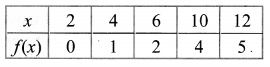
(ii) a table;
(iii) an arrow diagram;
(iv) a graph
Let f :A → B be a function defined by f(x) =
B = {0, 1, 2, 4, 5, 9}. Represent f by
(i) set of ordered pairs;
(ii) a table;
(iii) an arrow diagram;
(iv) a graph
answer:
f: A → B
A = {2, 4, 6, 10, 12}, B = {0, 1, 2, 4, 5, 9}
A = {2, 4, 6, 10, 12}, B = {0, 1, 2, 4, 5, 9}
f(x)=x/2-1
f(2)=2/2-1=0
f(4)=4/2-1=1
f(6)=6/2-1=2
f(10)=10/2-1=4
f(12)=12/2-1=5
(i) Set of ordered pairs
= {(2, 0), (4, 1), (6, 2), (10, 4), (12, 5)}
= {(2, 0), (4, 1), (6, 2), (10, 4), (12, 5)}
(ii) a table
(iii) an arrow diagram;


Comments
Post a Comment